The money to buy a new iPhone11 represents just over a fourth of a Thornton-Cleveleys first-time buyers mortgage deposit

Many mature readers of this Thornton-Cleveleys property market blog will remember buying their first home as 20 or 30 somethings, probably in Thornton-Cleveleys many years ago, yet read the newspapers now and feel it is all doom and gloom for todays’ first-time buyers.

So, I wanted to look at the facts, instead of newspaper headlines.

Back in 1995, the average Thornton-Cleveleys first time buyers house cost £32,150, whilst official figures state today it is £84,800

So, looking at today’s property prices, it could be perceived that owning a home is beyond the reach of most Thornton-Cleveleys first time buyers and that renting is the only way for younger members of Thornton-Cleveleys society to have a roof over their head .. or is it?

100% mortgages (so no deposit needed to be saved) were rife in the 2000’s and Northern Rock were famous for their 125% mortgages (i.e. you borrowed 25% more than what you were paying for the house, again with no deposit). Yet when the credit crunch hit in 2008 such mortgages disappeared overnight – ending the dream of homeownership for many. Yet would it surprise you to hear that 95% mortgages (i.e. the first-time buyer would need to save a 5% deposit) have been available since late 2009 and 100% mortgages (i.e. no deposit) were made available in 2016.

It is £78 per month cheaper to buy a typical Thornton-Cleveleys first-time buyer home than to rent the equivalent property.

Prospective Thornton-Cleveleys first-time buyers could make a saving of £940 per year on average if they moved from renting to owning. My calculations assume that first-time buyers raise a deposit of just 5 per cent and make mortgage payments over 35 years with the Barclays 95% mortgage with a fixed interest rate of 2.48 per cent interest. At this level…

Today, the average deposit needed by a

Thornton-Cleveleys first-time buyer is £4,240

Those able to raise that deposit, would pay £299 pm on average in mortgage payments, while the average rent for the same property would be £377 pm and the household income to support such a mortgage would only need to be from £17,902 pa.

Of course, buying your first home is a massive financial commitment and investment with up-front costs to ponder on, yet long-term the financial benefits can be substantial. With annual savings of £940 a year, this can really mount up over time and, of course, once the mortgage is paid off, one will have a valuable asset.

Yet, the elephant in the room is the raising of the 5% deposit

 Well most first time buyers, even most of you who are now in your 50’s and 60’s may have used the Bank of Mum and Dad to help with the deposit, yet it’s only fair that most parents still expect their offspring to contribute to the deposit and this is where it comes down to choice. I have spoken to many of my friends and family to reconfirm my initial thoughts that it comes down to priorities and choices in life. To save the deposit mentioned above, sacrifices are required to save that amount of money.

According to a survey in 2018, the average millennial goes out two nights a week and spends on average £63.36 per night out, that’s nearly £6,600 per year – a very expensive hobby. Nearly a third of millennials surveyed had smashed their mobile phone in the last 12 months. Then there is the obsession of having the latest tech, with the need to constantly be upgrading one’s mobile phone. In fact, the cost of the brand new iphone11, recently released, is just shy of £900. Even those on contracts can expect to pay upwards of £80 per month for the newest phone upgrade, yet if they kept their old phone after two years, a sim only deal with the same minutes and data would set them back no more than £25 per month … it comes down to choices. Save for a deposit and reduce your expenditure on socialising and mobiles etc and have a valuable asset at the end of your mortgage or continue as you are.

I am not here to make a judgement – everyone is free to make their own choices in life – all I am doing is highlighting the real situation – so you are aware of the full story.


282 FACEBOOK PowerPoint Image makerSlide1

Is This the End of No-Fault Section 21 Evictions for the 36,498 Blackpool Tenants?

In the late spring, the Government announced that they were planning to end no-fault evictions for tenants living in private rented accommodation.

I have had a number of Blackpool landlords contact me anxious that removing a tenant from their Blackpool buy-to-let property in the future had possibly become a lot more problematic. Yet, at the launch of the consultation on the changes to the piece of legislation relating to no-fault evictions (called the Section 21 amendments), the Government wanted to assure British landlords that they would be protected by the bolstering of the existing Section 8 legislation. The current Section 8 allows landlords grounds for recovery of their properties for reoccupation of the landlord, non-payment of rent and other legitimate factors.

17,401 Blackpool landlords are affected by this potential change in the law

Yet, it is comforting for Blackpool landlords and tenants in the fact that most competent letting agents very rarely have to evict a tenant. In the worst-case scenarios the tenant needs evicting (normally because rent hasn’t been paid) or because the landlord is either selling their buy-to-let investment or moving back into their property. Look at the consultation – it has been indicated that those grounds will not be removed from section 8 powers during the government’s consultation and the talk is they will be bolstered and improved. To put the removal of Section 21 notices into some context…

Only 22,527 section 21 notices made it to Court last year, out the 4.5million private rented households

Scotland banned no fault evictions (i.e. their own version of a Section 21) two years ago, and the model suggested by Westminster is similar to that of the new Scottish system. Landlords, tenants and agents have had to adapt north of the border, and there hasn’t been the mass exodus of landlords from the market since then.

Yet the call in the lettings and legal profession is … if the Government is intent on making these changes, we need well-funded courts which specialise in housing and tenancy matters (like there are for family law and children). Especially when the landlord manages the property themselves (without an agent), the issue of eviction comes about from a breakdown in communication between landlord and tenant. The courts could use their mediation skills to make it simpler and faster for tenants and landlords to obtain quick and available justice instead of the existing drawn out procedures under Section 8, which helps no one (not even tenants). This is important as the demand for Blackpool rental properties is growing and people need a home to live in – fact.

Blackpool needs an additional 829 buy-to-let properties per year for the next decade to meet the demand from Blackpool tenants

As an agent in Blackpool, I know most Blackpool landlords consider buy-to-let in Blackpool as a long-term investment, with the average landlord looking to retain their buy-to-let property for at least 10 years and beyond. Talking to other agents around the country, over 90% of Section 21 notices are made by the tenant, not the landlord. Removing the Section 21 notice could affect tenants more than landlords.

Replacing Section 21 with a process that requires a landlord to firstly have a good reason, and secondly go through due process, will likely remove the more unprincipled landlords from the property market. That is great news as those unprincipled landlords will either sell their properties to new buy-to-let Blackpool landlords, or to tenants who want to buy them. So, it could be a small win for people looking for a new Blackpool home, and a disappointment for unprincipled landlords simply looking for a cash cow ‘have no care about the property or tenant’ investment vehicle.

If you are a Blackpool landlord and want to know more about this, whether you are a landlord of ours, a Blackpool landlord with another Blackpool agent or a self-managing landlord, feel free to drop me a line or pick up the phone (I don’t bite) to chat about the implications of this and other legislative changes that are on the horizon.

281 facebook.jpg


Thornton-Cleveleys Buy To Let Annual Returns Hit 12.04% in Last 10 Years

Many Thornton-Cleveleys people ponder the best places to invest their hard-earned savings and the best piece of advice I can give you is to do your homework and speak to lots of people. It depends on your attitude to risk versus reward. Normally, the lower the risk, the lower the reward whilst a higherriskis normally associated with the possibility of higher returns, yet nothing is guaranteed. At the same time, higher risk also means higher possible losses on your investment – yet if one looks at the bigger picture, the biggestthreat to investing, predominantly when the investment is made in the short term, isn’t risk but actually volatility.

So where should you invest? Building society, the stock market, gold or property are an option. This article isn’t designed to give you advice – just show you how different investments have performed over the last decade.

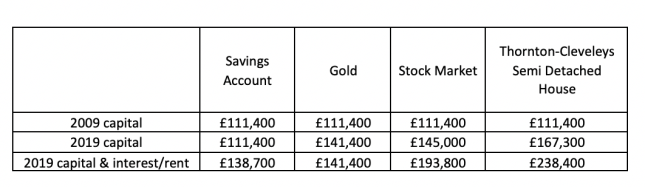
Let me start with the humble semi-detached house in Thornton-Cleveleys … which in 2009 was worth £111,400 … so assuming I bought that property for that figure, then I looked at what if I had invested the same amount of money in a building society, into gold and finally the stock market…Screenshot 2019-05-04 23.51.16

Putting your money into the stock market (FTSE100) would have brought a return of 30.2% on your capital over those 10 years and an average of 3.79% a year in dividends (making an overall increase of 74%).

Gold doesn’t earn interest – yet it has increased in value by 26.9% over the same 10 years whilst putting your money in the building society, the money hasn’t increased in value, but would have earned you interest of 24.46% or the equivalent of 2.21% per year.

Investing in an average semi-detached house in Thornton-Cleveleys over the last 10 years has seen the capital increase by 50% (an equivalent of 4.14% per annum) and the income (i.e. the rent) has provided a return, based on the original purchase price, of 114% or the annual equivalent of 7.9% … meaning the overall return, based on the original purchase price of an average semi-detached property in Thornton-Cleveleys, is 12.04% per annum.

image001

Notwithstanding No.11 Downing Street’s grab at the profits of buy to let landlords by hitting the buy to let sector with several fiscal punishments with a 3% stamp duty level, a decrease in high rate tax relief for landlords and an increase in rate of CGT on residential property profits, the facts remain that ‘bricks and mortar’ is still one of the preeminent and most constant investments available.

The bottom line is, the buy to let investment remains the mainstay of the British property market, serving to support aspiring homeowners as they work to conquer the, sometimes difficult, financial obstacles of home ownership. With Central Government over the last 30 years only paying lip service to address the lack of new homes being built or tackling the affordability on a consequential scale, it is highly probable this will continue for the next 5/10/15 years as there will always be a call for a respectable, and above all, honest buy to let landlords delivering decent housing to those that need it.


Thornton-Cleveleys House Prices Fall 2.7% in a Year

Thornton-Cleveleys House Prices Fall 2.7% in a Year

What does that mean for local Landlords and Homeowners?

The balancing act of being a Thornton-Cleveleys Buy To Let landlord is something many do well at. Talking to numerous Thornton-Cleveleys landlords, they are very aware of their tenants’ capability to pay the rent and their own need to raise rents on their rental properties.  Despite the ‘perceived ‘dark clouds of Brexit, evidence suggests many landlords feel more confident than they were in the Summer and Autumn of 2018 about aiming to push rents higher on their Thornton-Cleveleys Buy To Let properties.

Looking at the data for the last 7 years, this shows that throughout the Summer months, the rents new tenants have had to pay on move in have increased at a higher rate than during the colder months of Winter.  This is because the Summer months are normally a time when renters like to move, meaning demand increases for rental properties yet supply remains pretty ridged.

Yet the Winter stats buck that trend and this is great news.

Rents in Thornton-Cleveleys on average for new tenants moving in have risen 0.7% for the month, taking overall annual Thornton-Cleveleys rents 2.9% higher for the year

However, several Thornton-Cleveleys landlords have expressed their apprehension about a slowing of the housing market in Thornton-Cleveleys and I believe, based on this new evidence, they may be overstated.  Before we get the bubbly out though, the other part of investing in property is what is happening to capital values (which will also be of interest to all the homeowners in Thornton-Cleveleysas well as the Thornton-Cleveleys Buy To let landlords).   I believe the Thornton-Cleveleys property market has been trying to find some form of balance since the New Year.   According to the Land Registry….

Property Values in Thornton-Cleveleys are 2.7% lower than they were 12 months ago

Yet, these figures reflect the sales of Thornton-Cleveleys properties that took place in the Summer of 2018 and only exchanged and completed during the late Autumn / early winter months of last year.

The reality is the number of properties that are on the market in Thornton-Cleveleys today has risen by 6% since the Summer

and that will have a dampening effect on the property market.  As tenants have had less choice, buyers now have more choice .. and that will temper Thornton-Cleveleys property prices as we head into the middle of 2019.

Be you a Thornton-Cleveleys landlord or Thornton-Cleveleys homeowner, if you are preparing to sell your Thornton-Cleveleys property in 2019, it’s important, especially with the rise in the number of properties on the market, that you are pricing your propertyrealistically when you bring it to the market.  With the likes of Rightmove, Zoopla and OnTheMarket on everybody’s mobile phones and laptops, buyers have access to every property on the market and they will compare and contrast your home with other properties like yours – and will more than likely dismiss your property rather than view it.

To all the Thornton-Cleveleys homeowners that aren’t planning to sell though – this talk of price changes is only on paper profit or loss.  To those that are moving .. most people that sell, are buyers as well, so as you might not get as much for yours, the one you will want to buy won’t be as much.  Look at the deal as a whole, the difference between what you sell yours for and what you buy at.  Finally, all the Thornton-Cleveleys landlords– keep your eye’s peeled – I have a feeling there may be some decent Thornton-Cleveleys buy to let deals to be had in the coming months.

New Home Building in Blackpool 2018 rises to 68.1% above the post Millennium average

Nationally, the number of new homes created in 2018 was 222,194, the highest since 1989. Yetsince 2002, the average number of properties built in the UK has only been 146,700 per year. You would think, seeing all the new homes sites around, you could ask are we building too many houses, especially off the back of those impressive 2018 build figures? However, to keep up with the ever-growing population, lifestyles and people living longer, official reports state the Country actually needs 240,000 new homes built every year to just stand still.

It is estimated, by the Chartered Institute of Housing, that the current national backlog of new homes required is in the order of 4.7 million (i.e. because of the bottled-up household formation by younger adults living with parents, shared housing and unaffordability). As a Country, we cannot meet all these needs immediately and it will take time to build up an effectual plan to address these issues.

Looking closer to home, you will also see from the graph below the long-term trend of new homes building (the yellow dotted line) has been going in a downward direction. Although, the 2018 new homes build stats for Blackpool are 68.1% above the post Millennium average. (You will see some years are negative, this is because more houses were demolished than built).

image001

The cure is simple: we need more homes… yet who is going to build (and pay) for them. Some Blackpool people will say why can’t the local authority build most of them?

In 2018, 276 new dwellings were created in the Blackpool Council area and of those 276; interestingly 23 were Council and Housing Association homes


So, if our local authority had a more ambitious annual target of say an additional 500 homes on top of those figures, where could they be built and how would they be paid for? Of course, there are the normal apprehensions about infrastructure issues such as roads, schools, hospital capacity and doctors’ surgeries but our local authority has a Local Plan and that has the locations of where they envisage the new housing will be built (and the infrastructure that goes with it).

The Tories lifted the cap on what local authorities could borrow to build Council houses in late 2018 meaning Councils could borrow more money to build more Council houses. Let’s say we built those 500 homes a year for the next 5 years in Blackpool, that would cost the local authority £375 million to build, which would produce in total £17.4 million in rent. At current interest rates, the interest would be £9.5m per year leaving a surplus of £7.9m for property maintenance and management – meaning the Council houses pay for themselves!

Therefore, what does all this mean for Blackpool homeowners and Blackpool buy-to-let landlords?

Well, the chances of our local authority getting the full funding for an extra 500 homes a year is slim as there is only so much money to borrow. If every UK local authority got funding for 500 additional homes a year for the next 5 years, an impressive 867,500 homes would be built in those 5 years but that would require the councils to borrow £130.1bn – and Central Government doesn’t have that kind of money for Councils to borrow (more like £10bn to £15bn).

The 4.7million long term housing shortage means house prices will remain strong in the long term (despite blips like Brexit etc). Demand for private rental properties will continue to grow and if you read my recent article on rents, this can only be good news for Blackpool landlords. This attention on the housing crisis by the Government is good news for all Blackpool homeowners and Blackpool buy to let landlords, as it will encourage more fluidity in the market in the longer term, sharing the wealth and benefits of homeownership for all. However, in the short term, demand still outstrips supply for homes and that will mean continued upward pressures on rents for tenants and stability on house prices.

Blackpool House Prices up 14.6% in the last 5 Years

Over the last 5 years, we have seen some interesting subtle changes to the Blackpool property market as buying patterns of landlords have changed ever so slightly.

The background to this story was the recently published set of buy-to-let (BTL) lending statistics. Roll the clock back 12 months and 6,700 BTL mortgages were granted (in the same month) for £900m, meaning the average BTL mortgage was £134,200. Looking at last month’s figures, and as one might expect with the Brexit issue overhanging the property market, the lending figures were down, yet not by the amount I originally thought. Last month, just over 6,100 new buy-to-let mortgages were granted for a total sum of £800m (meaning the average landlord mortgage was a respectable £131,100). Yet, when I looked back to the boom year of the 2014 property market, in the corresponding same month, only £1,030 million was borrowed on 8,300 buy-to-let properties (meaning the average buy-to-let mortgage was £124,100). It seems Brexit is having no effect on landlords buying habits.

Looking closer to home in Blackpool, throughout 2018, I have been regularly chatting to more and more landlords, be they seasoned professional Blackpool BTL landlords or FTL’s (first time landlords) and their attitude is mostly positive. Instead of reading the scare-papers (oops sorry newspapers), those Blackpool landlords that look with their eyes, will see the Blackpool property market is doing reasonably well, with medium term rents and property values rising; as quite obviously from the mortgage figures .. landlords are still buying.

The question I get asked all the time is .. “What type of buy-to-let property should I buy?  You can make money from property through both the rent (expressed as a yield when compared to the value of the property) and how the actual value of the home itself changes.

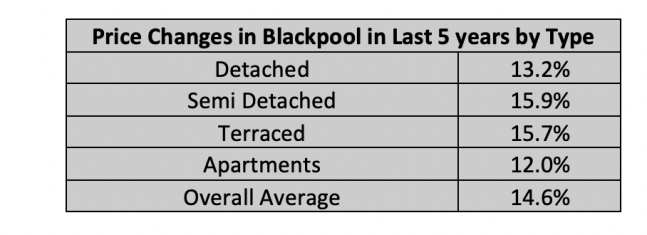
Since 2014, property values in Blackpool have risen by 14.6%.

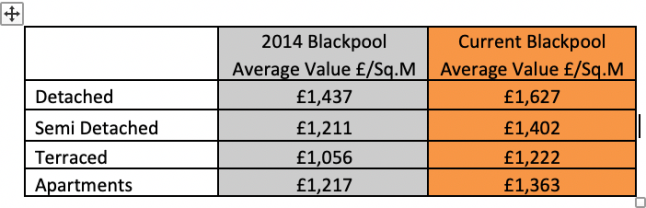
We have records of what each type of property (i.e. Detached/Semi/Terraced/Apartments) has achieved per square metre going back 20 years … and looking back over the last 5 years, these are the numbers ..

Screenshot 2019-03-09 12.29.24

image001

They all look to have similar percentage uplifts, however as you can see from the table there is in fact some variation throughout and although only slight this can equate to thousands of pounds in monetary terms.

Screenshot 2019-03-09 12.31.39.png

This has proved that semis and terraced houses have performed the best .. although like the £/Sq.M figures, these are just averages. When investing, whilst Blackpool apartments haven’t been the best performers in terms of capital growth, they do tend to generate a slightly better yield than houses, probably because several sharers can afford to pay more than a single family. But houses tend to appreciate in value more rapidly and may well be easier to sell, simply because there are fewer being built.

Now these are of course averages, but it gives you a good place to start from. The bigger picture here though is this – irrespective of what is happening in the world, be it Brexit/no Brexit, China, Trump, whatever, Blackpool people still need a roof over their heads and we as a Country haven’t built enough homes to keep up with the demand since the late 1980’s. This means even if we have a short term wobble in 2019 when it comes to property values ..in the medium term, demand will always outstrip supply and prices and rents will increase – because, I doubt the local authority, let alone Westminster, have the billions of pounds required to build the one hundred thousand Council houses per year nationally for the next decade to fix this issue – meaning as the population increases, the only people who can fulfil the demand for accommodation in the medium term is the private BTL landlord.

Before I go …on average, housing associations and local authorities have built around 26,500 houses each year since 2010. The Labour government had a lower average, building about 19,000 homes per year, yet in the 1960’s, under both administrations, 180,000 council homes were built per year!

Thornton-Cleveleys Homeowners 57% More Likely To Live in a Home with 3+ Bedrooms than those that Privately Rent

The conventional way of categorising property in Britain is to look at the number of bedrooms rather than its size in square metres (square feet for those of you over 50!). My intuition tells me that homeowners and tenants are happy to pay for more space. It’s quite obvious, the more bedrooms a house or apartment has, the bigger the property is likely to be. And it’s not only the tangible additional bedrooms, but those properties with those additional bedrooms tend to have larger (and more) reception (living) rooms. However, if you think about it, this isn’t so surprising given that properties with more bedrooms would typically accommodate more people and therefore require larger reception rooms.

In todays Thornton-Cleveleys property market, the Thornton-Cleveleys homeowners and Thornton-Cleveleys landlords I talk to are always asking me which attributes and features are likely to make their property comparatively more attractive and which ones may detract from the price. Over time buyers’ and tenants’ wants and needs have changed.

In Thornton-Cleveleys, location is still the No. 1 factor affecting the value of property, and a property in the best neighbourhoods can achieve a price almost 50% higher than a similar house in an ‘average’ area. Nevertheless, after location, the next characteristic that has a significant influence on the desirability, and thus price, of property is the number of bedrooms and the type (i.e. Detached/Semi/Terraced/Flat).

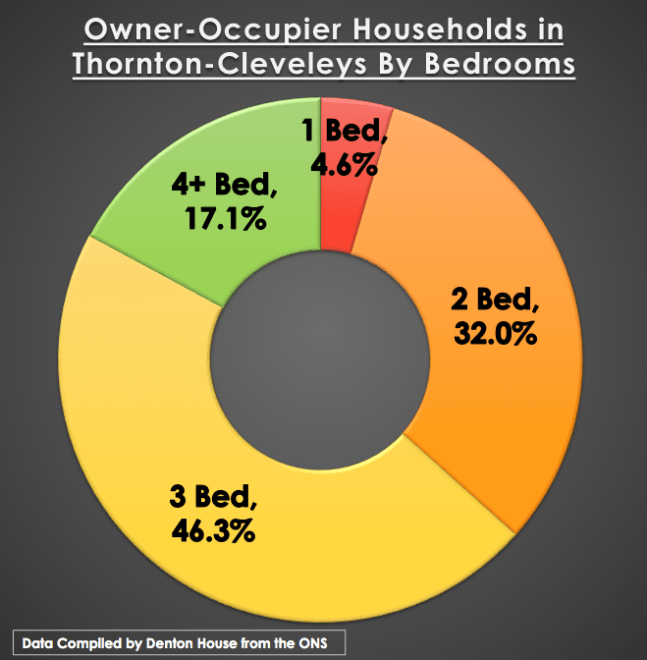
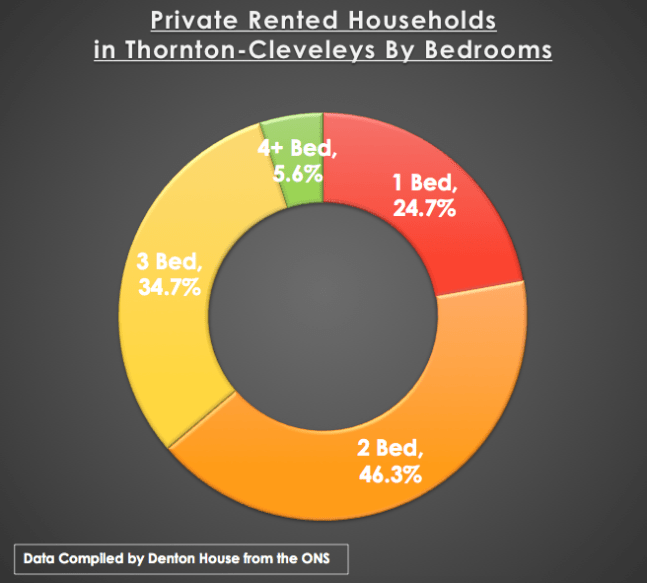
The number of bedrooms for owner-occupiers very much depends on the size of the family and the budget, whilst Thornton-Cleveleys landlords have to consider the investment opportunity. In this article, I have analysed Thornton-Cleveleys’ housing stock into bedrooms and tenure. Initially looking at Thornton-Cleveleys (FY5) homeowners…

image001

And now the Private rented sector …

image002

screenshot 2019-01-15 20.14.44

It can quite clearly be seen that Thornton-Cleveleys owner-occupiers tend to occupy the larger properties with more bedrooms. This would be expected due to the demographic of homeowners and people that privately rent.

However, this shows there could be opportunities for Thornton-Cleveleys buy to let landlords to purchase larger properties with more bedrooms to attract tenants requiring properties with more bedrooms. However, before you all go buying larger 4 bed and 5 bed mansions to rent them out, a lot of bigger properties in Thornton-Cleveleys don’t make financial sense when it comes to buy to let.

For numerous years Thornton-Cleveleys buy to let landlords have been the lone buyers at the smaller one and two bed starter homes of the market, as they have been lured by elevated tenant demand and eye-catching returns. Some Thornton-Cleveleys landlords believe their window of opportunity has started to close with the new tax regime for landlords, whilst it already appears to be opening wider for first time buyers. This is great news for first time buyers .. but one final note for Thornton-Cleveleys landlords .. all is not lost .. you can still pick up bargains, you just need to be a lot more savvy and do your homework ..one source of such information with articles like this is the Blackpool Property Market Blog http://www.blackpoolpropertyblog.com.


40.6% of All Blackpool Properties were Bought Without a Mortgage in the Last 7 Years

For most Blackpool people, a mortgage is the only way to buy a property. However, for some, especially Blackpool homeowners who have paid off their mortgage or Blackpool buy to let landlords, many have the choice to pay exclusively with cash. So the question is, should you use all your cash, or could a mortgage be a more suitable option?

Well, looking at the numbers locally…

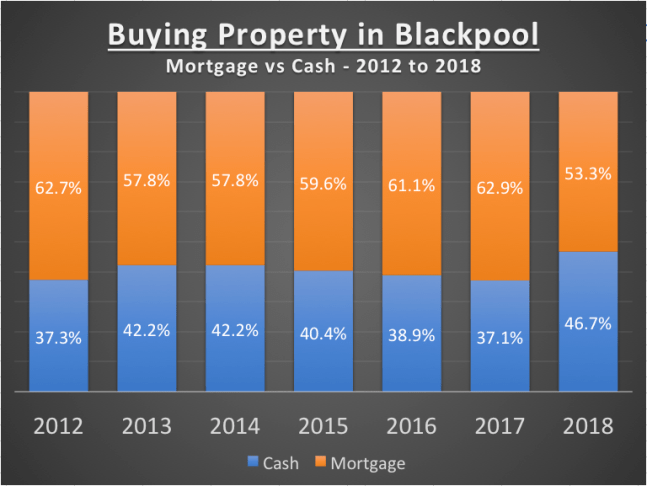
5,402 of the 13,295 property sales in the last 7 years in Blackpool were made without a mortgage (i.e. 40.6%)

Interesting when compared with the national average of 31.9% cash purchases over the last seven years. Next, I wanted to see that cash percentage figure split down by years. As you can see from the graph, this level of cash purchases vs mortgage purchases has remained reasonably constant over those seven years…

image002

Next, if you are going to go for a mortgage, the next question has to be whether you should fix the rate or have a variable rate mortgage. In the last Quarter, 90.57% of people that took out a mortgage, had a fixed rate mortgage at an average interest rate of 2.27%, although what did surprise me was only 65.79% of the £1.429 trillion mortgages outstanding in the whole of the UK were on a fixed rate. The level of mortgage debt compared to the value of the home itself (referred to as the Loan to Value rate – LTV) was interesting, as 61.9% of people with a mortgage have a LTV of less than 75%. Although, one number that did jump out at me was only4.33% of mortgages are 90% and higher LTV – meaning if we do have another property slump, the number of people in negative equity will be relatively small.

Next, looking at the actual number of properties sold, it can be clearly seen the number of house sales has dipped slightly in 2018…

image001

So those are the numbers … let us have a look at the pros and cons of taking a mortgage, with specific focus on Blackpool buy to let landlords.

Taking a mortgage will help a landlord increase their investment across more properties to maximise the return, rather than putting everything into one Blackpool buy to let property. This will enable the landlord to ensure if there a void in the tenancy, there should still be rent coming from the other properties. The flip side of the coin is that there is a mortgage to pay for, whether or not the property is let.

The other great motivation of taking a mortgage is that landlords can set the mortgage interest against the rental income, although that will only be at the basic rate of tax by 2021 due the recent tax changes. Banks and Building Societies will characteristically want at least a 25% deposit (meaning Blackpool landlords can only borrow up to 75%) and will assess the borrowing level based on the rental income covering the mortgage interest by a definite margin of 125%.

A lot will depend on what you, as a Blackpool landlord, hope to attain from your buy to let investment and how relaxed you would feel in making the mortgage payments when there is a void (interestingly, Direct Line calculated a few months ago that voids cost UK landlords around £3bn a year or an average of £1000 per property per year). You also have to consider that interest rates could also increase, which would eat into your profit … although that can be mitigated with fixing your interest rate (as discussed above).

So, with everything that is happening in the world, does it make sense to buy rental properties? Now we help many newbie and existing landlords work out their budgets, taking into account other costs such as agent’s fees, finance, maintenance and voids
in tenancy. The bottom line is we as a country aren’t building enough property, so demand will always outstrip supply in the medium to long term, meaning property values will keep rising in the medium to long term. That’s not to say property values might fall back in the short term, like they did in 2009 Credit Crunch, the 1988 Dual MIRAS crash, the recession of the early 1980’s, the 1974 Oil Crisis, the early 1930’s Great Depression … yet every time they have bounced back with vigour. Therefore, it makes sense to focus on getting the best property that will have continuing appeal and strong tenant demand and to conclude, buy to let should be tackled as a medium to long term investment … because the wisest landlords see buy to let investment in terms of decades – not years.

Thornton-Cleveleys Homeowners Have Made an Annual Profit Of £4,598 Since the Millennium

As we go full steam ahead into 2019, it’s certain that the Thornton-Cleveleys housing market in 2018 was a little more restrained than 2016 and 2017 and I believe this will continue into 2019. Property ownership is a medium to long term investment so, looking at the long-term, the average Thornton-Cleveleys homeowner, having owned their property since the Millennium, has seen its value rise by more than 134%.

This is important, as house prices are a national obsession and tied into the health of the UK economy as a whole. The preponderance of that historical gain in Thornton-Cleveleys property values has come from the growth in Thornton-Cleveleys property values, while some of it will have been enhanced by extending, modernising or developing their Thornton-Cleveleys home.

Taking a look at the different property types in Thornton-Cleveleys (FY5), and the profit made by each type, makes interesting reading..

Screenshot 2019-01-10 09.38.26.png

image001.png

However, we can’t forget there has been just over 60% inflation over those 18 years, which eats into the ‘real’ value (or true spending power of that profit) … so if we take into account inflation since 2000, the true spending power of that profit has been lower.


 So the ‘real’ value of the profit, after inflation, in Thornton-Cleveleys has been £2,807 per year.. still nothing to sniff at.

I wanted to show you that even though we had the 2008/09 Credit Crunch property market crash where, depending on the type of Thornton-Cleveleys property, property values dropped between 15% and 20% in 18 months … Thornton-Cleveleys homeowners over the long term are still better off than those renting.

Moving forward, the question I get asked time and again is what will happen in the future to the Thornton-Cleveleys Property market? Irrespective of what is happening in the World, Europe or even Central London, the biggest factor over the medium tolongterm to ensure that this level of house price growth is maintained in Thornton-Cleveleys is the building of new homes both locally and in the country as a whole. Whilst we haven’t had the 2018 stats yet, Government sources suggest this will be nearer 180,000 to 190,000, a decrease from the 2017 figure of 217,350 new households being created. When you consider that we need to build 240,000 households to equal demand (immigration, people living longer, higher divorce rates and people co-habiting later in life etc) … demand will outstrip supply and unless the Government start to spend billions building council houses .. this trend will continue for years (and decades to come).

Another factor is that whilst Thornton-Cleveleys landlords have been hit with higher taxes to enable them to actually be a landlord most, in every national survey, still intends to increase their portfolio in the medium to long term. The youngsters of Thornton-Cleveleys see renting as a choice, giving them flexibility and options that being tied to a home cannot give… thus meaning demand will continue to grow and landlords will be able to enjoy increased rents and capital growth, although those very same Thornton-Cleveleys buy to let landlords will have to work smarter in the future to continue to make decent returns (profits) from their buy to let investments. Even with the tempering of house price inflation in Thornton-Cleveleys in 2018, most Thornton-Cleveleys buy to let landlords (and homeowners) are still sitting on a copious amount of growth from previous years.

The question is, how do you, as a Thornton-Cleveleys buy to let landlord, ensure that continues?

Since the 1990’s, making money from investing in buy to let property was as easy as falling off a log. Looking forward though, with all the changes in the tax regime and balance of power, making those similar levels of return in the future won’t be so easy. Over the last ten years, I have seen the role of the forward thinking agents evolve from a person collecting the rent to a more all-inclusive role; I call it, ‘strategic portfolio leadership’. Thankfully, along with myself, there are a handful of agents in Thornton-Cleveleys whom I would consider exemplary at this landlord portfolio strategy where they can give you a balanced structured overview of your short, medium and long-term goals, in relation to your required return on investment, yield and capital growth requirements. If you would like such advice, speak with your current agent – whether you are a landlord of ours or not – without any cost or commitment, feel free to drop me a line.


Hamza

Hamza.anwar@martinco.com

07889021247

Live in Blackpool? About to Retire and Privately Rent? You Could be £1,300 a Year Worse Off!

You read the personal finance pages of the newspapers and it all seems to be the impending pensions crisis … where people aren’t saving enough for their retirement. But it’s not the lack of Blackpool peoples’ future pension incomes that are my immediate concern. The fact is that so many of the future retirees in Blackpool over the coming decade, who never bought their home in the Millennial years of the 1990’s and 2000’s, will have to make some tough decisions regarding what house they live in when they retire anytime between now and 2038.

In Blackpool, there are 3,588 privately rented households, where the head of the household is between 50 years and 64 years of age (meaning they will be retiring anytime between now and 2038). They are working now and easily paying the rent, yet what happens when they retire?

A Blackpool retired couple, who currently privately rent and who have paid their fully qualifying NI stamp over the last few decades are likely to retire with the couples State Pension of £1,091 per month plus a tiny bit of private pension if they are lucky. Given that the average rent in Blackpool is £481 a month – a lot of that pension will be lost in rent. This means taxpayers will have no alternative but to step in and top up the rent payments with Housing Benefit, yet…

The maximumhousing benefit for a couple in Blackpool is currently £368.33 per month … leaving a significant gap when you consider the average rent in Blackpool is £481 per month

It is most people’s opinion that retirees are either council tenants or own their home outright. Looking at these figures though, it looks like both these ‘mature’ private renters could be having to make some decisions on their lifestyle and where they live, possibly looking at downsizing the home they rent to make things more affordable in their old age. Also, the government will be in for a horrible surprise as more of Blackpool people retire and continue to rent from a private landlord. Numerous Blackpool private renters, with little or no savings, will have to rely on Housing Benefit which will put greater pressure on the public purse.

The average Blackpool retiree will need to find £1,352 pa to stay in their privately rented home after retirement

A recent report from Scottish Widows suggested that 1 in 8 OAP’s will be privately renting by 2032, up from the current one in 15.47 OAP’s whom currently private rent (or 6.47%). In fact, in that report they said the equivalent of more than one-third of the whole annual NHS budget would be spent on Housing Benefit for OAP’s in retirement living in private rented property.

What does this mean for mature Blackpool homeowners? I see many using equity release schemes to stay in their homes to pay for a better retirement and others more open to downsizing, selling their large home to a family that needs it and moving into a smaller apartment or bungalow … yet lets be frank – they aren’t building bungalows in large numbers in Blackpool anymore.

And for the Blackpool landlords? Well with the younger Millennials showing no appetite in jumping onto the homeownership bandwagon anytime soon, it can only result in the demands on the buy to let market from Blackpool tenants rising substantially. Of course, many Millennials will inherit money from their home owning parents in the coming few decades, yet a lot won’t as it will be spent on nursing home care and any leftovers (if any) split between siblings.

For those retiring in post 2050/2060, there is better news as official reports suggest those retirees will enjoy a State Pension approximately similar to today’s pensioners with auto-enrolment into top-up private pensions through their employer.

The solution to all this is to build more homes, of course. Last year we created/built just over 217,000 households in the UK, up from a post Millennial average of just under 150,000 households a year. We need to get back to the building booms of the late 1960’s and early 1970’s when on average 300,000 households were built … but back to reality … that won’t happen so it looks like we are turning into a nation of renters, which is of course good news for Blackpool’s buy to let landlords!